There are few names in nineteenth-century British jewellery as intriguing as that of Mrs Charlotte Isabella Newman (1836–1920). At a time when the profession was almost entirely dominated by men, Newman established one of London's most respected jewellery houses, creating jewels for aristocratic and royal clientele while earning an international reputation for originality and craftsmanship.
Today, her work is rarely encountered at auction; complete suites are rarer still.
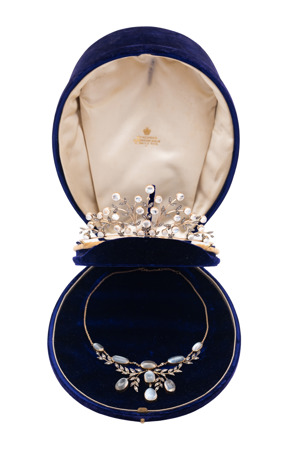
Offered in our forthcoming Silver, Watches & Jewellery auction is this splendid example; a late Victorian moonstone and diamond tiara and necklace suite, preserved in its original fitted case and attributed to Mrs Newman. It is a suite that perfectly reflects the qualities that made her one of the most innovative designers of her generation.
Late Victorian Moonstone and Diamond Tiara and Necklace Suite
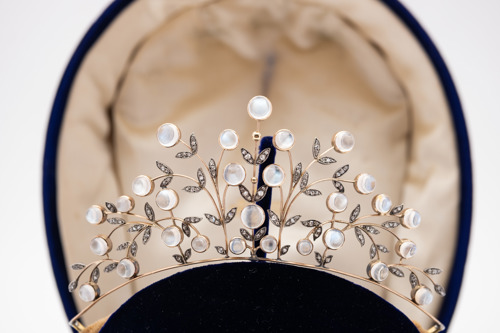
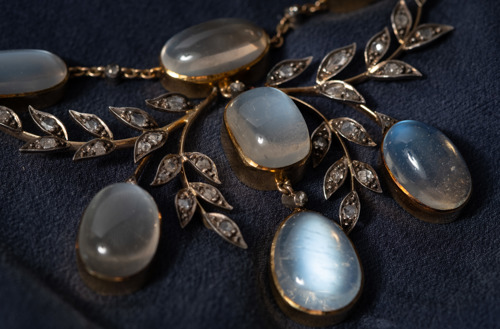
Comprising a beautifully balanced tiara and matching articulated necklace, each designed with flowing naturalistic branches set with graduating cabochon moonstones and highlighted with delicately mounted rose-cut diamonds. The necklace mirrors the design of the tiara, its articulated construction allowing the central pendant and moonstone drops to move freely, creating both elegance and vitality.
Perhaps the most remarkable aspect of the design is the choice of gemstone. Around 1900, tiaras were traditionally fashioned from diamonds and the established precious gemstones, rubies, sapphires and emeralds. Moonstone was a highly unconventional choice for a suite of this importance. Rather than relying on brilliance alone, Newman embraced the gem's mysterious, shifting light, allowing its soft luminosity to become part of the design itself. It was a confident artistic decision by a designer who consistently challenged convention.
That originality defined her career.
After studying at London's Government School of Design, Newman continued her education in Paris and travelled widely across Europe, spending countless hours studying museum collections and the treasures of the ancient world. Classical Greek and Roman jewels, Renaissance goldsmiths' work and archaeological discoveries all left a lasting impression on her imagination. Rather than simply reproducing historical jewels, she absorbed their craftsmanship and reinterpreted them in a style that was entirely her own.
Close up of the tiara
Her talent soon attracted the attention of the celebrated goldsmith John Brogden, whose workshop was renowned for archaeological revival jewellery. Newman became one of his principal designers and, following his death in 1884, she established her own business in London, retaining many of the craftsmen from Brogden's workshop. From her premises in Savile Row she built a clientele that included members of the aristocracy and the Royal Household, while exhibiting internationally and receiving a Médaille d'Honneur at the Paris Exposition for her work.
Her designs were celebrated for their individuality. Jewellery historian Shirley Bury observed that Mrs Newman rarely produced two pieces alike, preferring to create original works rather than repeat successful patterns. That philosophy is beautifully illustrated in this moonstone suite, a jewel that combines technical excellence with an unmistakably artistic vision.
Newman's legacy endures today. Her designs are preserved in the collections of the Victoria and Albert Museum, which also holds examples of the jewels she created during her years with John Brogden, together with many of her original design drawings. They stand as a testament to a designer whose imagination and craftsmanship helped shape British jewellery at the turn of the twentieth century.
Close up of the necklace
Beautifully preserved in its original fitted case, this remarkable suite is more than an outstanding example of late Victorian jewellery. It is a rare opportunity to acquire the work of one of Britain's most original and influential jewellery designers, whose creations continue to be admired by collectors, historians and museums alike.
Lot 630 is offered with a guide of £15,000-£25,000 at Bearnes Hampton & Littlewoods Fine Jewellery Auction, 25th August 2026