Every auction has its stories. Some begin with great collections, celebrated makers or important provenance. Others begin far more quietly—with a piece of jewellery whose true significance has yet to be discovered.
This Georgian emerald ring is one such story.
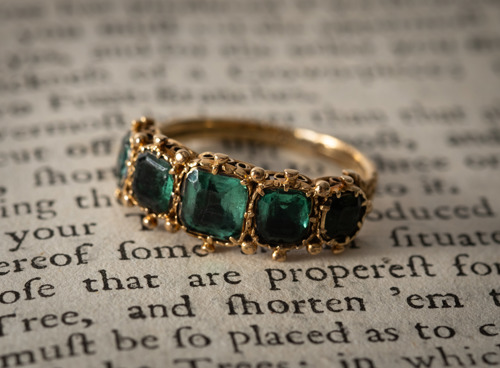
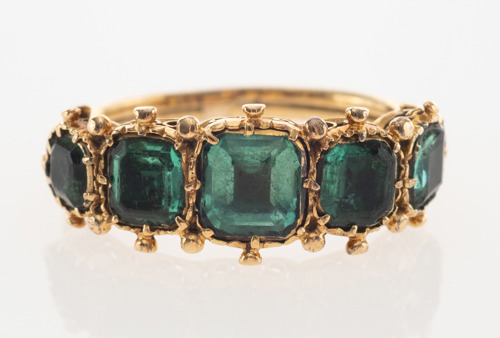
The five-stone emerald and gold Georgian ring in question
How many Georgian jewels have been lost over the centuries?
We will never know.
For generations, antique jewellery has disappeared into the melting pot, valued only for its precious metal while centuries of craftsmanship, artistry and history have been lost forever. Every so often, however, a remarkable survivor emerges—one that escapes being judged simply by its weight in gold and is recognised instead for what it truly represents.
Lot 633 in Bearnes Hampton & Littlewood’s Fine Jewellery Auction on 25th August 2026 is one such fortunate survivor.
This elegant Georgian ring had a narrow escape before arriving for specialist assessment. In a time when gold prices remain exceptionally strong, it is increasingly tempting to view unwanted jewellery primarily through the value of its precious metal. Yet, as this ring demonstrates, the story behind a jewel can often be worth considerably more than the gold itself.
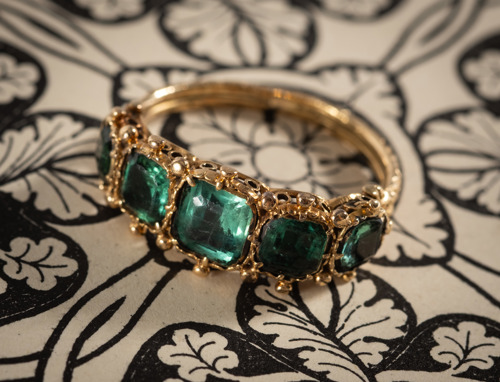
A closer examination revealed a beautifully preserved Georgian jewel, set with a graduated row of five cushion-cut emeralds displaying a vibrant colour. Each stone is housed within traditional foiled closed-back settings, a technique used by Georgian jewellers to enhance the depth and richness of coloured gemstones. The raised gallery, formed from individually crafted hoops with intricate beadwork, together with the finely chased split shoulders, demonstrate the remarkable hand craftsmanship of the period.
The emeralds themselves are particularly noteworthy. Four of the five stones display very good clarity, impressive for gemstones that have survived more than two centuries. Alongside the original Georgian construction and distinctive setting style, they make this a highly appealing example for collectors of early jewellery.
Estimated at £2,000–£3,000, the ring’s importance lies not simply in its gold content, but in its rarity, craftsmanship and survival.
The current strength of the gold market has understandably encouraged many people to consider selling unwanted jewellery. For some pieces, this may be the right decision. However, antique jewellery deserves a closer look before any decision is made.
A gold buyer is primarily assessing the value of the precious metal. An auction specialist approaches a jewel differently, considering the complete object: its age, construction, gemstones, condition, rarity, provenance and desirability among collectors. These qualities can transform an item from something ordinary into something genuinely significant.
Look at the emeralds catching the light.
Georgian jewellery is particularly sought after because so much has been altered, remodelled or lost over time. The survival of an original setting and period construction is increasingly valued by collectors, preserving not only the gemstones themselves but also the design, techniques and craftsmanship of the era. Once a historic jewel is melted down or dismantled, those details—and the story they carry—can never be recovered.
At Bearnes Hampton & Littlewood, discoveries such as this are among the most rewarding aspects of our work. Jewellery inherited from family, found among forgotten possessions or simply considered “old gold” can sometimes reveal a much richer history.
Not every piece will prove to be a hidden treasure, but every piece deserves to be understood before its fate is decided.
This Georgian emerald ring will now take its place in our Fine Jewellery Auction on 25th August 2026, as lot 633 with a guide of £2,000-£3,000 where it can be appreciated not merely as a gold ring, but as a beautifully preserved example of Georgian craftsmanship.
Because once a piece of history is melted, it can never be rediscovered.
If you have jewellery tucked away in a drawer, don’t ask first what it is worth in gold. Ask first what it is. The answer may surprise you.